 Sustainable Cities and Communities

UNESA prioritises pedestrian access on campus

Universitas Negeri Surabaya (UNESA) prioritises pedestrian access on campus by restricting motor vehicles entering the university environment and by providing pedestrian areas, both set out in Rector's Circular Letter (Surat Edaran Rektor) No. B/60690/UN38/HK.01.01/2023 on the Climate Action Plan, dated 31 July 2023 (Universitas Negeri Surabaya, 2023), and by providing 18,339 metres of dedicated pedestrian paths and 1,142.35 metres of sheltered walkways between buildings in 2025 (Universitas Negeri Surabaya, 2026). UNESA reported these figures in its Social, Economic and Environmental Impact Report 2025, which the Rector sent to the Ministry of Higher Education, Science and Technology on 6 August 2026 (Universitas Negeri Surabaya, 2026).
Policy basis
| Policy | Detail |
|---|---|
| Title | Surat Edaran Rektor Universitas Negeri Surabaya Nomor B/60690/UN38/HK.01.01/2023 tentang Climate Action Plan di Lingkungan Universitas |
| Title (English) | Rector's Circular Letter of Universitas Negeri Surabaya No. B/60690/UN38/HK.01.01/2023 on the Climate Action Plan within the University Environment |
| Number | B/60690/UN38/HK.01.01/2023 |
| Date set | 2023-07-31 |
| Date reviewed | - |
Angka 1 huruf a
"Pembatasan kendaraan bermotor yang masuk ke dalam lingkungan universitas" Angka 1 letter a: Restricting motor vehicles entering the university environment. |

Angka 1 huruf e
"Pengadaan area pedestrian untuk pejalan kaki" Angka 1 letter e: Providing pedestrian areas for walkers. |

Dedicated pedestrian, bike and connecting paths on UNESA campuses, 2025 (metres)
| Type of path | Length (metres) |
|---|---|
| Dedicated pedestrian paths | 18,339 |
| Sheltered connections between buildings | 1,142.35 |
| Dedicated bike lanes | 38,387 |
| Total | 57,868.35 |
Pedestrian priority on campus
Universitas Negeri Surabaya (UNESA) restricts motor vehicles entering the university environment and provides pedestrian areas for walkers through Rector's Circular Letter No. B/60690/UN38/HK.01.01/2023 on the Climate Action Plan within the university environment, dated 31 July 2023 and addressed to the whole academic community (Universitas Negeri Surabaya, 2023). In its action area on reducing carbon emissions, UNESA lists the restriction of motor vehicles entering the university environment (point 1a) and the provision of pedestrian areas for walkers (point 1e), alongside a shuttle bus between campuses in place of private vehicles (point 1c) and electric bicycles as alternative transport (point 1d) (Universitas Negeri Surabaya, 2023). The 2025 impact report shows pedestrian infrastructure in place on UNESA campuses in 2025, in line with point 1e (Universitas Negeri Surabaya, 2026).
UNESA provided 18,339 metres of dedicated pedestrian paths and 1,142.35 metres of sheltered connections between buildings on its campuses in 2025, reported in the transport theme of its Social, Economic and Environmental Impact Report 2025 (PDF page 67) (Universitas Negeri Surabaya, 2026). The report counts the pedestrian paths separately from the 38,387 metres of dedicated bike lanes, so the pedestrian figure does not include cycling routes (Universitas Negeri Surabaya, 2026). It states that every path is fitted with road markings, pavement (trotoar) or another clear physical form to support safety, comfort and accessibility for the academic community (PDF page 67) (Universitas Negeri Surabaya, 2026).
UNESA built the paths to move short trips on campus from motor vehicles to walking. The report states that the paths and the sheltered inter-building connections let the academic community walk or cycle between campus facilities, and that the infrastructure encourages them to choose walking or cycling over motor vehicles for short trips, so that academic activities can go on without relying on motor vehicles (PDF pages 67 to 69) (Universitas Negeri Surabaya, 2026). Photographs in the report show a marked pedestrian path at Campus 1, a roofed walkway at the Faculty of Mathematics and Natural Sciences (FMIPA) and a paved walkway with a handrail and a tactile guiding strip at the Faculty of Education (FIP) (PDF pages 68 and 69) (Universitas Negeri Surabaya, 2026).
UNESA measured the full campus network over the calendar year 2025, from 1 January to 31 December 2025 (PDF page 17) (Universitas Negeri Surabaya, 2026). The report gives the length by campus only for the combined network of pedestrian paths, bike lanes and inter-building connections: 28,392.75 metres at Campus 1, 18,975.60 metres at Campus 2 and 10,500 metres at Campus 5, 57,868.35 metres in total (PDF pages 67 and 68) (Universitas Negeri Surabaya, 2026). The report describes the paths as available and used within the UNESA campus area, and records them as part of UNESA's strategy for a sustainable internal transport system, in line with SDG 3, SDG 11 and SDG 13 (PDF pages 67 to 69) (Universitas Negeri Surabaya, 2026).

A sheltered walkway connecting buildings at the Faculty of Mathematics and Natural Sciences (FMIPA) (Figure 51 of the 2025 impact report). (Universitas Negeri Surabaya, 2026)
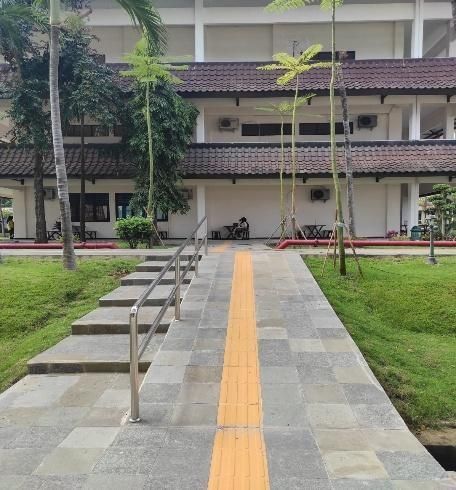
A pedestrian connection between buildings at the Faculty of Education (FIP), with tactile paving and a handrail (Figure 52 of the 2025 impact report). (Universitas Negeri Surabaya, 2026)
Related News (2)
Universitas Negeri Surabaya. (2023, July 31). Surat Edaran Rektor Nomor B/60690/UN38/HK.01.01/2023 tentang Climate Action Plan di Lingkungan Universitas [Rector's Circular Letter No. B/60690/UN38/HK.01.01/2023 on the Climate Action Plan within the University Environment]. https://statik.unesa.ac.id/profileunesa_konten_statik/uploads/sustain/file/00db8ba5-7298-43c3-a1ad-98c62b8c0128.pdf
Universitas Negeri Surabaya. (2026, August 6). Laporan Dampak Sosial, Ekonomi, dan Lingkungan Universitas Negeri Surabaya Tahun 2025 [Social, Economic and Environmental Impact Report of Universitas Negeri Surabaya 2025].